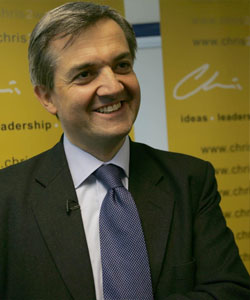
This article was first published on 10th November 2007. Nick Clegg beat Chris Huhne to become the Lib Dem leader on 18th December 2007 by just 511 votes and appointed his rival as the party's Home Affairs spokesman.
Much has been made in these first few weeks of the race to become leader of the Liberal Democrats about the similarities between the candidates.
Nick Clegg and Chris Huhne are both Westminster School-educated former MEPs with near-identical views nearly all the key issues.
Both became MPs as part of the Lib Dems strong showing in the 2005 elections. Both are English and will appeal to voters in key south and south east seats where the resurgent Tories are a major threat.
Indeed, Chris Huhne, currently his party's spokesman on environment issues, has a majority of just 568 in his Hampshire seat.
At 53, he is the more senior candidate. He ran against Sir Menzies Campbell in the last leadership election in early 2006, coming second, and is a former journalist and successful businessman.
Yet for all that his 40-year-old opponent is the favourite to win when the results are announced just before Christmas.
In an exclusive interview Chris Huhne explains why he should succeed Ming, why Sir Ian Blair must resign as Met police chief and why he is not convinced of the need for a new crime of incitement to hatred on the grounds of sexual orientation.
How's the campaign going?
Not bad. I mean we're picking up. I think we're getting there slowly. I always thought we'd have a nice long campaign.
And you've been through it before of course.
And I've been through it before so I know about pacing ourselves which is quite important.
How soon after Ming resigned were you up and running the campaign?
Well it took a bit of time because really weren't expecting it at all actually and so...
Because your rival had a website up very quickly.
Well I'm told that. I don't know whether Nick had managed through foresight or whatever be preparing anything but certainly we weren't expecting it.
I was very determined that there would be no question of a sort of Michael Portillo phone line moment, so we didn't do anything before the resignation.
Many people are disengaged in politics because they think the main parties are quite timid in the way that they react to things like the environmental challenges. Do you think the place for your party to be is the radical party?
Well it is. I think the absolutely key role for the Liberal Democrats is to make sure we are not just radical in the sense of putting forward radical proposals on climate change for example, although we are, but actually we're the only party that's in favour of changing the whole system.
That's a really fundamental message because the pool of votes which we should be able to attract in are those 40% of people who aren't voting at all.
If we can somehow energise and give back a sense of trust and faith in the political process to those people, we can enormously increase the number of people who vote Liberal Democrat.
Half the population describes themselves as liberal and so we've got potentially a great pool to draw from but we're not getting our message across effectively.
Are you talking about changing the electoral system through proportional representation and localism?
Well I mean the whole constitution. Localism and proportional representation are the two key things. You've got to get power back to the people for them to understand that actually they can influence their own lives and the communities they live in.
And so localism is absolutely essential but obviously you also need fair votes, every vote has to count wherever you come from.
This is an area where the Tories have quite effectively come onto your ground, talking about localism returning, returning power down to as local a level as possible.
With proportional representation, don't you think that a coalition with either of the other main parties is the only way that you're going to achieve it?
You can get proportional representation either through winning an overall majority itself and then giving it away by introducing proportional representation or you can do it through cooperation with other parties.
I don't know which one of those will come but we have to be prepared for either and be very ambitious about the party.
Ming very clearly said it would be a precondition for him before he would consider any kind of coalition. Would that be your policy?
Well I wouldn't use the word precondition, I see it as slightly differently. I would say that actually any party leader who seriously wants to talk about partnership politics has to think through the political consequences of that and the system that we work in.
You can't have partnership politics if you have an electoral system that means very small shifts of votes can suddenly lead to casino-like effect on different parties.
You can't have partnership politics either if the Prime Minister of the partnership government is able to call an election at whatever time, potentially therefore putting a coalition partner at serious danger.
Inevitably if you begin to think of what is necessary for partnership politics you begin to think through the consequences of changing the system.
The system we have at the moment, first past the post, is designed to victimise partnership politics, it is designed to extrude it from the political process and have nothing to do with it. So we've got to change that.
But you won't use the word precondition?
I won't use precondition simply because it's not a bargaining chip. It's actually whether you're on the right wavelength. I mean it's even more fundamental than a precondition.
It's just basically, if you really want to have a partnership in normal times as opposed to a national emergency like war, then do you understand what the consequences are for the system?
In your 2005 manifesto the Lib Dems said they will make homophobic incitement an offence on the same basis as inciting racial hatred. Is that your position?
No, I'm very supportive on that and I very much like the work that Steven Williams has been doing on homophobic bullying in schools, and appointing a bullying mentor, I think that makes a lot of sense.
But on the specific issue of incitement - the Tories aren't sure what they're going to do about it. Jack Straw's very keen on it. I was wondering as a candidate for leader, what's your view is on this specific provision?
Well I think that incitement for any violence is frankly it's already illegal. I'm not sure that taking in a further offence adds an awful lot.
But if it's necessary to do that then I'm up for it because I think frankly, you know incitement to violence, incitement to hatred and therefore potentially to violence is extremely dangerous.
I think it's quite similar to racial hatred in the sense that people cannot choose their sexuality and therefore it is innate. I think where you draw the line is on those issues where you can't, where you don't want to chill free speech on issues.
Where people can makes decisions legitimately about what they're saying and doing. I wouldn't want to go so far as to act as an obstacle in the law to freedom of speech but I would want to protect people who are targeted because of race or sexual orientation, anything which is an innate part of their character.
So would you say you're open to the argument?
Yes.
Jack Straw and the Labour government whenever they talk about this piece of legislation, constantly talk about it sending a message and it being a gesture. I was wondering what you felt about that given that the Lib Dems have always been critical of how many new laws we have.
In general I'm not in favour of using the legislative process to send messages. I mean I think there is a role for the government of making it clear, I don't know if you have to pass a law to do so.
But there is a role for government clearly in making it clear what is acceptable and civilised behaviour and what isn't.
I look with consternation at the fact that we have 3400 new criminal offences since 1997 and you know many of them are frankly completely redundant because they merely repeat things which were already illegal.
I just don't see the point of them other than as a press release.
It seems an awful odd way of going about attracting press attention to limber up the Treasury solicitor into coming up with yet another draft bill on something or other.
Are you the nasty party now?
No, of course not. Nobody in their right mind would spend a lifetime in Liberal Democrat politics unless they cared passionately about the values that we put forward about fairness, about the green future for our society, about decentralisation, about civil liberties.
Having been active in our politics since the early 1980s, having been through periods when our poll ratings were so low that it was within the margin of error and one pollster actually just had an asterisk because they couldn't find any Liberal Democrat supporters at all, it's astonishing to suggest that we are the nasty party because we are in any way motivated other than by belief in our values.
You mention the 1980s there and that leads me onto your reputation, your City days when you were a petrolhead. How much of that is true?
Well I wasn't a petrolhead. I mean I had a...
Tell us what cars you had.
I actually...
It's nothing to be ashamed of Chris, everyone was doing it in the 1980s.
The truth is that I started getting interested in global warming as an issue in the late 80s and I wrote columns in The Guardian about it and then in The Independent.
I also wrote a book called Real World Economics in 1990 which talks about global warming as being one of the greatest threats that we face.
But in terms of personal behaviour you still have to make ridiculous compromises. I mean I still fly around and buy my offset because we're in an economy which is in a process of transition.
All that stuff about cars is frankly nonsense, because I had a company car when I went to The Independent, which was a standard issue BMW.
I didn't have any choice about it, I actually a nice Alfa Romeo is what I really wanted, but they said I had to have a BMW because of the resale value.
It's something that the press obviously enjoy talking about. It leads me onto something else. You remember the 1980s and you were a professional by that decade already. Nick Clegg and David Cameron were still at school.
Age was an issue in Ming‘s resignation. Are you not worried that you might be a bit too old? You know, you're as old as Gordon Brown, you're a good 15 years older than...
13 years older than Nick. I am 13 years older than Nick. That's obviously up to people to decide in the leadership contest.
I am very lucky in that I look younger than I am. I am very energetic, I'm very fit, I usually leave anybody with me panting after running up the stairs so I don't think I have any problems with energy levels and I wouldn't undertake this job if I didn't think that I was able to lead the party very vigorously.
I also think that the background of having been in business and having built up a business and employed people and created wealth and having 19 years in journalism is, actually has some advantages.
A lot of people want, crave these days authenticity in politics and one thing which is tremendously suspicious for many voters is the fact that people come into politics at a very young age without any experience of the real world.
They're not necessarily on the same wavelength as most voters and they don't necessarily understand the same sort of concerns, the insecurities that people have to face in the normal working environment.
I do, I've been there, I've done that, I've bought the T-shirt and I think that that's actually, particularly against both David Cameron and Gordon Brown, quite an important point. David Cameron's only spent four years outside the Westminster bubble in his life, when he was working as a PR advisor for Michael Green at Carlton.
And Gordon Brown similarly, similar period when he was a researcher on Scottish telly. So, I think that's actually quite a strength.
Well as you've said you have experience running an organisation, you've had experience running a business. With the Met police what's your view on their chief executive? Do you think Sir Ian Blair should resign?
It seems to me that it's pretty inevitable, he was clearly where the buck stopped, that was the decision and I think he has to go and it does worry me actually that in a lot of government departments there is a sort of culture of impunity where people do not take responsibility for their own mistakes.
And you'd expect that same high standard across the board from all your Liberal Democrat ministers and ministers in other administrations such as Scotland?
Yes, I think you do. If somebody's responsible for a really crass error, the signal you send out if you leave them in post is that it doesn't matter making crass errors and so you're actually inviting people in future to make the same sort of mistake as there's no problem from their point of view if they do.
You're a former MEP. One of the things that we report on regularly are countries who have joined the EU but don't seemed to have fully understood their social responsibilities towards gay people.What can we do about that?
The role of the EU in instilling liberal values into central and eastern European transition countries has been absolutely crucial.
I can remember people saying we only need the EU for peacekeeping, mainly for the environment, global warming.
I can remember when I was doing country risk work the Prime Minister of Slovakia set out in a very brutally nationalist way to persecute the Hungarian-speaking minority in Slovakia - 440,000 people.
He even went so far as to change the local government boundaries, to put them in minorities, to remove the right to educate their children in Hungarian and so forth.
And frankly if he had gone on, it would be almost inconceivable that the Hungarian state next door to Slovakia would not have had to intervene because of the political pressures on them.
You could easily have had an appalling mess like Bosnia and Serbia and Croatia. So, the EU response was you go ahead and do that and you'll no longer be entitled to join the EU, this is not acceptable behaviour, it was very firm and it stopped it.
We need through that gradual process of trying to send very clear signals, grading them obviously depending on what is acceptable behaviour in a civilised liberal democratic state and what isn't.
One of the most moving things of my entire career was going and visiting all of the central and eastern European countries when they first came to the capital markets in the 1990s and giving them ratings.
I realised just how much they wanted to be a part of the European democratic family and all that meant. And you know, particularly somewhere like Lithuanian or Latvia or Estonia, which had been gobbled up by the Soviet Union after their very brief moment of independence and suddenly actually becoming a country which is able to have their parliament and traditions and so forth, it's actually very moving.
And I think it doesn't take very much to move them on. I mean in the case of Poland I think it's also a thing you have to remember which makes it a rather special case.
Poland as a state didn't exist from the partition at the end of the 18th century between Russia and the Hapsburgs and the Prussians right the way through until after the First World War.
The institution that became the vehicle for Poland's cultural identity was the church.It was terribly important in preserving the cultural identity but a certain amount of baggage went with it.
And the baggage is taking a little bit of time to shed. But some of the more staid and conventional attitudes, traditional attitudes towards gays, follow ineluctably from some of that history. It will work its way out. And we don't need to speed it up.
Are you going to change the name of the party?
No, well I have no intention of changing it. I'm a social liberal and that means, I came through the SDP but in fact my history in terms of my family, my grandfather couldn't be more liberal.
He was named William Ewart Gladstone Murray, so you could imagine the kind of family he was born into.
If he wants it will there be a place for Ming on your front bench?
Oh absolutely, we are enormously indebted to Ming for stabilising the party and to making sure that we are getting more professional with the policy and with the organisation and he has a fantastic amount, I think, still to bring.
He was very hard done by, by the press in particular. There is undoubtedly an element of ageism in the whole attitude towards Ming and I said the same about Charles.
One of the things which I think any leader of the party must feel is that we have an enormous amount of talent within the Parliamentary party, we've got plenty enough talent to run a government in my view, and we need to be much more ambitious.
We're not going to take any nonsense, any condescension about the Liberal Democrats because we've actually got a fantastic front bench with a talent that we've got, Ming and Charles, all the other, Nick, Vince, all the other talent, David Laws.
We've got fantastic talent on the front bench and we can run a government. We should not hide our light under a bushel, we need to get out there and persuade people.

http://www.pinknews.co.uk/news/opinion/2005-6006.html
 After a year away from blogging, I have decided I can’t live without it.