SO here it is my first blog entry since 19th April.
In that time I have been to Miami, spent the day with schoolkids at Auschwitz, been on BBC Radio Ulster (personal goal ticked off the list - shame my mum wasn't listening!) reported on the election of Boris Johnson as Mayor of London, been to my first PMQ and got to sit in the Press Gallery which was just SO cool (thanks Kevin), talked St Paul's epistles with the only gay bishop in the Anglican communion (only out one obviously. Its faggot central as everyone knows) discussed the psychology of Ann Widdecombe with drunken Labour researchers, listened to London's first gay deputy Mayor relive the experience of his partner dying in his arms, and then be told he was not a 'fit person' to register his death - he went all the way to the Registrar General to have that obscene insult abolished.
I have brooded over getting an interview with David Cameron, then brooded over getting one with Gordon Brown, planned by birthday picnic on Primrose Hill, thought about growing my hair long, had a beautiful dinner with my friend Michael in his new flat, received news that my brother Dominic is a father for a third time, a girl called Megan, found myself agreeing with everything my mother was saying about Tibet, fought a losing battle with Snickers addiction, argued about the ban on gay blood donations with two people who knew a lot more about it than me, had dinner with someone I fully expect to be in the Cabinet in ten years, realised what an brilliant film Minority Report is, interviewed about a million interns and not slept enough.
Clearly no time for blogging - its SO 2007. But we shall keep at it when we find a moment.
Showing posts with label Boris. Show all posts
Showing posts with label Boris. Show all posts
Friday, June 06, 2008
Saturday, April 19, 2008
Hustings was a huge success
 This morning's Mayor of London hustings, organised by Stonewall, was packed - nearly 400 people were there to hear Ken, Boris, Brian speak alongside Sian Berry from the Greens and Lindsey German from Respect - The Left List.
Both the female candidates impressed the audience with their common sense answers and general demeanour. Sian, only 33, is particularly highly thought of not just in the Green party but among political watchers of all shades. I do hope she wins a seat on the London Assembly.
I was chairing the event, which was daunting, but I think it turned out OK in the end. At least the crowd was mostly well-behaved, with just a handful of people shouting out from the crowd. What is it with these people? How is shouting at people acceptable? It is just rudeness in my opinion.
Anyway, there was very little of that, though one person did shout at me at one point, accusing me (at the end) of not picking any black people. She didn't even mention Asians or other minorities. Racist.
Boris had an interesting time - both charming the audience and failing to convince them that he never really supported Section 28. I tackled him about his infamous comment piece where he compared civil partnerships to "three men and a dog" getting married, but he would not apologise.
Ken was in his comfort zone. I thought he dealt well with accusations about corruption - there are seven police investigations ongoing, apparently.
Anyway, I have chaired my first hustings, and I liked it. I guess I will only have to wait until 2012 for the next one!


Monday, April 14, 2008
Stonewall hustings event names chair

And it's me!
Yes, yours truly will be on stage at BFI Southbank (formerly the National Film Theatre) on FRIDAY 19th APRIL from 11am.
The whole thing is booked up, which is a bit scary, as is the prospect of trying to keep the peace between Boris Johnson, Ken Livingstone, Brian Paddick and Lindsey German, the Respect - The Left List candidate.
It will be the last hustings before voters go to the polls on May 1st, so the candidates will either be particularly combative or dog tired, we will just have to see.
Sunday, April 13, 2008
boris blears and the BNP

The Secretary of State for Communities has said that the Tory candidate for Mayor of London will "depend on attracting support in second preferences from BNP and UKIP supporters" to win the May 1st election.
Hazel Blears, who is in charge of the Labour party's local election campaign, made her assertion in an interview with The Sunday Telegraph in which she characterised the council elections as vital for David Cameron.
Labour is braced for considerable losses in the 4,500 seats up for election across England and Wales, with party insiders predicting as many as 250.
The party could lose control of Sheffield to the Liberal Democrats. Lib Dem leader Nick Clegg is an MP for the city.
It is Gordon Brown's first major electoral test since becoming Prime Minister last year. In cities such as Birmingham, Manchester, Newcastle and Sunderland, and 73 English district authorities, one third of the council seats are up for election.
Seven English district authorities will elect half of the council while in Wales all councillors in all 22 councils will be elected.
The Prime Minister already faces unrest among his own MPs about plans to extend detention without trial for terrorist suspects and the abolition of the 10p tax band, which took effect last week.
Meanwhile Tory leader David Cameron will be hoping to pick up support in northern England, particularly cities, where his party is currently absent.
"Cameron needs to show he can get real support in the North of England and Wales, beyond his political comfort zone in the shires. Not just a few gains here or there," said Ms Blears.
Her comments about Conservative candidate for Mayor of London Boris Johnson indicates that the battle for City Hall is set to remain ill-tempered right up until polling day.
"The London Mayoral will be very close, given the resources the Tories are ploughing into the capital," she told The Sunday Telegraph."
Success for Boris Johnson will depend on attracting support in second preferences from BNP and UKIP supporters, I am afraid."
Labour candidate Ken Livingstone, seeking a third term in office, has used the threat of a BNP candidate winning a seat on the 25-member London Assembly as a late theme in his campaign.
"Like all fascist parties the BNP seek power with populist policies but their aim is to divide communities and foster hatred and violence," he said last week.
"We have to get across one simple fact: there's only one way to stop the BNP, which is by actually going out to vote against them. A low voter turnout will help the BNP get elected."
He was speaking after the fascist party had called on its supporters to cast their second preference vote for Mr Johnson – an endorsement he utterly rejected.
"In this race, the Tory clown Johnson is a lesser evil than the Marxist crank Livingstone, so replacing the latter with the former would, on balance, be an improvement for the majority of Londoners," the party said in a statement on their website.
"Even if Johnson condemns the BNP a second choice vote for him gives you the chance to vote BNP as your first preference and still vote to get Livingstone out of office."
Ms Blear's advisers later said she had not mean that Mr Johnson was seeking the votes of BNP members, but he rejected that position.
"Regardless of whether or not she meant to suggest I was deliberately courting BNP votes, this is yet another cynical attempt by Labour to play politics with an issue on which all the mayoral candidates are united," he said.
"I have said before that I don't want the second preference vote of any BNP supporter.
"I believe my message of a fresh approach and new ideas for London will resonate with all voters."
For more click here.

Thursday, February 21, 2008
Interview with UKIP's candidate for Mayor of London
 The UK Independence Party is misunderstood and misrepresented, their candidate for Mayor of London tells me when we meet.
Gerard Batten is a somewhat unusual politician, in that he is a member of a parliament that he desires to have no power over the lives of his constituents.
As an MEP for London since 2004, he spends his days in Brussels trying to think up new ways to discredit and dismantle the European Union (or "ferment rebellion" as he describes it).
For a long time UKIP was seen as something of a joke by the political establishment, flirting with Robert Kilroy-Silk and appealing to the sort of voter who thinks the Tory party is full of bleeding-heart liberals.
They weren't laughing so hard in 2004, when the party took more than 16% of the vote in the elections for the European Parliament.
The party now has 10 MEPs, 30 local councillors and two members of the House of Lords who defected from the Conservatives.
Perhaps that is why David Cameron felt moved to refer to them as "fruitcakes, loonies and closet racists."
UKIP was founded in 1993, a year after Tory Prime Minister John Major signed the UK up to the Maastricht treaty.
Its aims and beliefs are simple: full withdrawl from the EU and the return of sovereignty to Westminster, the maintenance of the union between Scotland, England, Wales and Northern Ireland and an end to the present immigration arrangements.
Batten descibes the party as "libertarian" and denies they are racists. No one can deny that their message resonated with some Londoners – in the 2004 Mayoral elections UKIP candidate Frank Maloney came fourth, winning 6% (115,665) of first preference votes and 10% (193,157) of second preference votes.
Batten, a founder member of the party, is their candidate for Mayor of London in the May 1st election.
While unlikely to either unseat Labour's Ken Livingstone or defeat Tory candidate Boris Johnson or the Lib Dem's Brian Paddick, the party could win a seat or two on the London Assembly.
Though it should be noted that UKIP, who have nearly 17,000 members, advocate abolishing the Assembly.
Batten, who will be 54 next month, worked as a salesman for BT for 28 years before being elected as an MEP.
In person, he is fluid and likable, if somewhat exercised about the direction of the UK, and at times is reminiscent of Ricky Gervais in his tone and delivery.
His references to the views of cab drivers can seem more like Jim Davidson, but there is no doubting he is sincere in his beliefs.
A report in the Evening Standard last month claimed that Batten would end funding for Pride London and his comment that incumbent Mayor Ken Livingstone's distribution of funds to gay and ethnic minority events is "cultural Marxism" piqued my interest.
Batten contacted us to say he had been misrepresented, and we decided to speak to him about his policies on immigration, race and the politics of Europe.
PinkNews.co.uk: Let's start with the charges that UKIP is racist and has an agenda similar to that of the BNP.
Gerard Batten: We have people from different races and nationalities running for UKIP and among my friends who advise me on the Islamic issue, one of them is actually an ex-Sharia lawyer who converted to Christianity.
We don't have a problem with foreigners or people of other races. You can have a multi-ethnic society and it can work so long as people feel like they belong to the same society. What doesn't work is multiculturalism.
It creates division and especially when you've got now the idea of introducing Sharia law to the country. The whole thing is crazy. You can have a country where people have their own culture and their own customs but they've got to sign up to one legal system, one political system.
We want controlled immigration. The BNP have another agenda, which is ethnic cleansing, and if you talk to any of their activists that's what they want. I know that because that's what they've told me.
They were regretful about it but they had to explain to me that my wife and family would have to be deported at some point in the future if they ever came to power. My wife comes from the Philippines.
I don't understand their obsession with us, because they do seem to be totally obsessed with us. The kind of people that join UKIP wouldn't join the BNP. We get the occasional person who would go off and defect but they are possibly in the wrong Party to start with.
Read the rest of the interview here.

Wednesday, February 13, 2008
My interview with Brian Paddick, Mayor of London candidate

Brian Paddick is enjoying running for Mayor of London.
The Liberal Democrat candidate may be a distant third in opinion polls, but he has one distinct advantage in this race – lots of people know who he is.
The 2008 Mayoral election is already the most exciting contest since the post was established at the turn of the century.
Incumbent Ken Livingstone is facing a concerted (some would say co-ordinated) barrage of negative press on everything from cronyism to his alcohol intake.
After eight years of his rule London's main newspaper, the Evening Standard, has gone into anti-Ken overdrive.
The election is further enlivened by the presence of one Boris Johnson, the Tory candidate. He is no stranger to the press or the voters.
A journalist, broadcaster, columnist, scallywag and sometime Member of Parliament, he has been happily knocking lumps out of the Mayor and banking on his unique personality appealing to London's voters.
Faced with those rivals, even the most exceptional third party candidate would struggle to make his voice heard.
Paddick, who is 50 in April, does not have a track record as an elected representative, only rejoined the party he now represents two years ago, and he talked to the Tories about the possibility of representing them.
So why would not one party but two want him to run for Mayor? As a career Metropolitan police officer, he first came to the attention of the press over cannabis policy in the London borough of Lambeth.
For operational reasons, he took the decision as borough commander to concentrate resources on hard drugs. That meant cautioning instead of arresting people caught with amounts of cannabis small enough to be considered for personal use.
The fact that he was openly gay only gave the right-wing press more to be unhappy about. His career at Scotland Yard proved even more controversial, and he earned a reputation for honestly over the Jean Charles DeMenezes affair.
His account of when senior police officers knew that the man they had shot at Stockwell tube station in July 2005 was not a terrorist but an innocent electrician was at odds with that of the Commissioner, Sir Ian Blair.
It is no secret that Paddick had professional ambitions beyond the role of Deputy Assistant Commissioner, but he left the force at that rank in 2006, after 30 years service in the Met.
When asked about his lack of experience as an elected official, he claims:
"In terms of politics, there is nothing more political than the eighth floor of Scotland Yard."
He says that running for Mayor has allowed him to speak more freely than he ever could in uniform.
"It is a bit like being a senior officer again," he says of the campaign.
"Morning, noon and night it is TV and radio and newspaper interviews, so I am very comfortable with it. But it has the bonus that I can say what I want.
"It took a while for me to convince myself that I wasn't going to get hauled in front of the Commissioner every time I gave an interview, which was the situation it had got to in the police.
"So it's quite liberating. I am in my comfort zone.
"If Ken and Boris keep taking lumps out of eachother like they are now then I might be the last man standing."
To read the rest of the interview click here.

Friday, January 25, 2008
The cabal around Ken

Although I think he has done his fair share of bad things, I am a bit of a fan of Ken Livingstone.
Why?
Because he is a proper Londoner. He likes a drink of whisky when he is answering Assembly questions? Good lad.
He accurately reflects the cheeky, lairy and cocky instincts of many of us in this city.
Channel 4 did their best with their expose documentary about Ken to dig some serious dirt, but I have to say that if all they could find after eight years in office was a bit of boozing, a streak of arrogance and some dodgy loans to dodgy community projects, then Ken must be cleaner than I thought.
The most hilarious part of the "expose" however, was the revelation that Ken had surrounded himself with a cabal of former Socialist Alliance comrades and - get this - employed them AND paid them salaries.
As I lay in bed this morning listening to Ken on the Today programme, I was amused by the thought that, in adopting the same alarmist tone that Martin Bright did in his Channel 4 hack job, you could make anyone sound sinister.
"A member of a tiny elite who think they are born to rule, he siezed control of the Conservatives when they were at their lowest ebb.
"Vandalising this once-great party, he moved quickly to surround himself with like-minded cronies.
"Committed to fanatical market solutions, he has learned, at least in public, to temper his hard Thatcherite views.
"However, with his gang, their committment to capitalism and the overthrow of the Blair/Brown consensus remains undimmed.
"There is Boris, a fellow member of the secretive Bullingdon Club, on over 60k a year in a sinecure job for life as MP for Henley.
"Two-brains Gove, feared for his ability to rip opponents apart.
"The intimdating figure of Nick Boles, a man who manipulates policy to suit the new, rightwing agenda.
"All of these men were close to Cameron as he plotted his rise to power, most of them given highly-paid jobs at Westminster, the better to advance their leader's cynical agenda."
Easy.
Sunday, January 20, 2008
September 07 - Boris Johnson interview
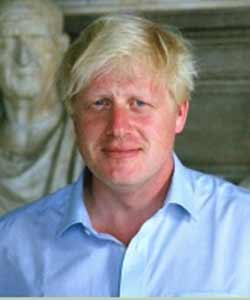
At this time of this interview Boris was one of the four Tories vying to become the party candidate for Mayor of London. He won the selection on 27th September 2007. The election for Mayor of London will be held on May 1st 2008.
When I meet Boris Johnson in a Westminster cafe it becomes apparent, immediately after he shambles in and launches himself into a chair, that 10am is not optimum Boris time.
As he puts it in his diary of the 2001 election campaign, Friends, Voters, Countrymen, it is "a pretty ungodly hour for someone accustomed to journalism."
The interview had been in the pipeline well before Labour activists started taking swipes at him over his views on everything from civil partnerships to climate change.
In fact, the day after Boris announced his candidacy amid chaotic scenes outside City Hall several weeks ago, his press officer enthusiastically agreed to an interview with PinkNews.co.uk
The month of August intervened, and when we finally sit down to talk about his views on gays and gay issues, he has been roundly condemned as hostile to the LGBT community by left-wing groups nervous about his bid for the Conservative party nomination for Mayor of London.
In many ways he is reminiscent of Michael Foot - sartorially shambolic, though the suits have got better - and the general impression of not really caring about bourgeois concerns like neatness.
In the words of one critic, he looks like he has to keep a pitchfork in his back pocket to deal with his straw-coloured mess of hair.
He also has that vagueness that Foot possessed.
Many of Boris' stream of consciousness responses trail off or come to a sudden stop, but there is an impressive intelligence to his answers. One thing is for certain - he is not afraid to question measures that some gay people take as an article of faith - a new law of incitement to homophobic hatred among them.
43-year-old Boris - the 'Johnson' seems somehow redundant - is one of four candidates for the Conservative party nomination for Mayor of London. Andrew Boff, an IT consultant and publisher, joins Kensington & Chelsea councillors Warwick Lightfoot and Victoria Borwick in the contest, which has been opened up to the public for the first time.
All Londoners on the electoral register are eligible to vote by phone or postal ballot.
This "open primary" of voters closes on 26th September and the Tory candidate will be announced soon after. Boris, the clear front-runner, stakes out his message to London's gay community pretty clearly - he is a libertarian.
He thinks Section 28 was a bad idea, he voted in favour of civil partnerships and he will "fight against" homophobic attacks. That probably means he will attempt to use his powers to combat them, but could just as easily mean he will pile in, head first, to bash the homophobes himself.
That's the thing about Boris. He claims he is always being misinterpreted.
The many hundreds of articles he wrote in his years as a rightwing journalist and columnist do give his opponents easy pickings, he admits.
"I am on record with loads of provocative articles about loads of things, but if you take the article as a whole, they always amount to robust common sense," he claims.
He laments the tactics of Labour activists, who have pre-empted even his selection as Tory candidate by producing a 17-page document highlighting a range of those provocative statements from his pre-2001 journalism.
One quote in particular, taken from his 2001 book Friends, Voters, Countrymen, has angered and upset many gay people:
"If gay marriage was OK - and I was uncertain on the issue - then I saw no reason in principle why a union should not be consecrated between three men, as well as two men; or indeed three men and a dog."
This infamous passage actually refers to an incident where Boris was jogging and was verbally assaulted by "three youths."
He challenges them, they respond that they had formed a bad impression of him from a TV appearance, and he wonders if comments he once made on BBC current affairs programme Question Time (see above) were the reason they disliked him.
"What I was saying was that I am generally a libertarian," is Boris' response.
"What they are trying to do is they are trying to invent a character or create a turnip ghost, a kind of scarecrow figure they can attack because its much more convenient to have some sort of crypto-fascist, foam-flecked, Norman Tebbit-type Tory instead of me.
"They have gone back through thousands of articles, millions of words, to try to find a few phrases that they can take out of context to demonstrate I am something that I am not."
But clearly comparing a loving gay relationship with "three men and a dog" is in any context insulting.
He disagrees, and denies that such comments imply that civil partnerships are not equal to marriage and are instead are just a sort of contract.
"No, no, no, no, no," insists Boris. "I am genuine - I come from a family, I have Muslim ancestors, my ancestors believed in polygamy and I believe in loving relationships between all sorts of people to be valid, I really do."
He pauses for a moment, suddenly aware that he might have caused even more outrage. "I don't want to get myself into more trouble than I need to be," he adds.
"I am in favour of civil partnerships and I voted in favour of them.
"I was cycling up Shaftesbury Avenue the other day and there were two guys in a rickshaw who had just got married and they said, "Hey Boris we just got married" and it was wonderful."
On Section 28, which in fairness he did vote to repeal on one occasion, the incumbent Mayor of London, Ken Livingstone, has directly attacked his record.
"He struck a stance in support of the anti-lesbian and gay Section 28 and now wishes to be seen as supporting London's diversity," Ken said.
Again, in this race, the 'Livingstone' also feels slightly redundant.
The aforementioned 17-page report from left-leaning think tank Compass also highlighted some comments from Boris, written before he became MP for Henley in 2001 that appear to support the aims of Section 28.
"Slowly Labour is winning the battle it really cares about, the Kulturkampf, adjusting what can be said, and what cannot be said... Homosexuality is to be taught in schools." The Spectator 29 April 2000.
"I am not sure how widespread this new right-on mood really is. Metropolitan opinion was wrong-footed over Section 28." The Spectator 29 April 2000
Boris accepts the historic anger of gay people over towards the Tories over Section 28.
"I disliked all that (the way the Tories acted in the 1980s) and what I disliked about it was the way they were trying to whip up people's feeling of identification with the Tories by trying to make them hostile to another group.
"I hate all that stuff. In a way this is also my objection to the way the current incumbent is running London. It's all about trying to build up loyalty by trying to bash other groups."
I suggest that this would be a perfect opportunity to apologise to the gay community for Section 28.
Surprisingly, given that he has probably apologised more times than any other mainstream politician, he rejects this relatively easy option.
"I hate all this gesture politics. I am not convinced of the political value of endlessly apologising to absolutely everyone.
"On Section 28, what it was trying to do, what the whole argument was really about was about homophobia and tolerance.
"It wasn't really about the practicalities - it was about what you thought about it. It wasn't ideological - it was personal and I dislike it because I think all human hatreds are, when you dissect them, all irrational human hatreds are always really about your own feelings about yourself in some way.
"Anyway I think it's all bollocks and the sooner we get over it the better."
The existence of LGBT liaison officers within the police seemed to be news to Boris, but he is keen to praise the Met generally.
"I didn't know about those community support officers working specifically with the gay community but I'm in favour of safe neighbourhood teams and teams of community support officers that work with communities of all kinds.
"I think it's a fantastic way of improving everybody's sense of security on the streets of London."
Many groups, among them Stonewall, argue that attacks motivated by hatred of gay people should be covered by a new homophobic hate crime law. Boris takes a different view on the likely effects of such a law, especially on people's right to criticise homosexuality.
"Of course I want everybody to feel safe, and I deplore homophobic attacks, I think they're outrageous and disgusting and I will fight against them if I'm lucky enough to be Mayor.
"The point I'm trying to make to you is I loathe acts that encourage hatred of groups. But sometimes the very measures we take can kind of stir things up rather than produce harmony.
"What I worry about is that you have erosions in free speech that I don't think anyone in the gay community would ultimately support. We are all basically, what we want is for people to debate freely and rationally and not to succumb to bigotry."
Ken has, of course, been very vocal in his support for the gay community. Boris says that funding for Pride London will continue if he becomes Mayor ("The idea of gay Pride seems very good. Right on!") and the community generally is one he stresses his support for.
"London has a fantastic record of being attractive to gays around the world and being a place gays feel they can come and be safe and where they will have a tolerant society. That's what I want."
He even tacitly agrees that the office can be used to encourage other cities to become involved with the global struggle for gay equality, while making clear he will not have a "foreign policy" like Ken Livingstone.
"I'm not in favour of the Mayor intervening on every matter of global controversy but yeah I think there are things he can do to improve people's lives elsewhere."
A lot has been written about Alexander Boris de Pfeffel Johnson's background.
Eton and Oxford-educated, he has been close to party leader David Cameron since university.
The seemingly bumbling Boris has been editor of The Spectator, Brussels correspondent and later a columnist for the Daily Telegraph, and MP for Henley since 2001.
Michael Howard fired him from the frontbench in 2004 amid accusations he lied about his extra-marital affair with journalist Petronella Wyatt. Brought back to frontline politics by Cameron, he has proved popular as shadow higher education minister.
His many TV appearances have added to the public perception of Boris as a sort of Bertie Wooster-ish genial buffoon, but that convenient caricature conceals an ambitious political animal.
He did not bumble into a high-profile political career – indeed in his 2001 diary of his campaign for Parliament, he says he "always knew" he would become an MP.
Despite his early ambition, he smoked cannabis in his youth. Today he takes a traditional Tory line on London's established drug culture.
"I'm deeply against drugs. I loathe them. I think they destroy lives and they've changed since my last experiences of cannabis, which were a long time ago.
"I don't want the police to concentrate on rifling through the sock drawer of every student in the hope of finding a rabbit dropping of cannabis resin.
"I think if they do find it they should take action and I don't think they should be tolerant but what we want are serious crimes to be dealt with as well, and that was the point I was trying to make about cannabis.
"I have to accept as someone who took it years ago is that the drug has changed and it's far more potent and everything I read now tells me it has much more damaging psychotropic effects and it's a much more effective gateway drug than it used to be.
"I think most people strongly disapprove of drug culture. I don't think anybody really wants to see London turning into anything like Amsterdam was a few years ago, last time I was there, with a really sleazy atmosphere and lots of places really suffering from the tolerance of drugs."
A few months ago, the smart money was on another Cameron ally, Nick Boles, winning the Tory nomination for Mayor of London. Unfortunately, Boles dropped out unexpectedly when he was diagnosed with cancer, from which he is expected to make a full recovery.
Boris denies his very late entry into the race was David Cameron's idea, and claims he had thought of running for Mayor before Nick Boles withdrew from contention.
"I wont deny it had crossed my mind but I am a friend of Nick and a supporter of Nick and I was very, very sad when he had to pull out - and he encouraged me to do it."
As for his own credentials, as the only candidate for the Tory nomination never to serve in local government in the capital, he has come under fire as a carpetbagger.
"Well I've always loved London. I've always thought London was a fantastic place. I lived in London on and off most of my life.
"And I remember when the idea (of an elected London Mayor) was mooted years ago by my predecessor, actually, Michael Heseltine, thinking my God that's a good idea - we do need a spokesman, the place does need a voice."
A voice silenced by Margaret Thatcher when she abolished the Greater London Council.
"I think it is a bit unfair to blame me. I was at school."
It's a fair point. Boris is well known for his devotion to cycling around London, but of late he has been more concerned with buses.
"I do take the bus when my bike is stolen, as I take the tube. I normally, every day I ride a bike. I've taken all sorts of buses across London recently.
"I used to take the 277 every day. I used to get off at Canary Wharf, with my friend Yvette Cooper (now the housing minister).
"She used to sit next to me on the top deck. Me and Yvette Cooper – God, we used to slug each other, we'd have these ferocious arguments."
Boris has made some strong statements about safety on buses, a big issue for many Londoners instinctively scared of gangs of teenagers who get free travel. His law and order stance is designed to appeal both to natural Tories and older voters.
"Most under sixteens are great kids, but there is a problem," says Boris, warming to his theme.
Weeks of meeting disgruntled bus passengers has galvanised his view that this issue is a vote-winner.
"Travelling around London quite a lot on the buses, talking to loads of, particularly elderly people, it's the biggest issue that's being raised with me at the moment.
"And this is something that's directly in the power of the Mayor to sort out.
"I don't understand why people say the office of Mayor holds no power - he has huge direct power over things like that and there are things I could do immediately if I was lucky enough to get the job on day one I think to elevate the problem of kids abusing their privileges.
"We should take away their right to free travel if they are abusing it and we should take it away for a good long time and that would be a good deterrent."
Of course a policy towards youth crime and unemployment needs to be as much stick as carrot.
Boris is on-message with his proposed solutions for London's disenfranchised teenagers, echoing the sentiments of new Tories such as Shaun Bailey, the party's candidate in the Hammersmith parliamentary seat.
His suggestions range from male role models to old-fashioned respect for authority. "When I was a child there was a real difference between children and adults from the one that there is now.
"I mean there was no question. When I was a child all adults were given automatic respect, I don't mean to exaggerate but you know what I'm driving at, it was a different thing.
"There was more nervousness of adults, people were reluctant to shout at adults to insult them, children are much more confident about things today, which in some ways is a good thing - I'm not saying all the change has been completely bad.
"Because in many ways it's been a liberation, but the trouble is that there are too many kids that simply don't have any understanding of what the boundaries are in their lives.
"They don't have any rules, they don't have any figures of respect, they don't have any role models that they can identify with, they don't have any idea of what it might be to be a grown up human being with a productive interest in the rest of his or her society."
Boris has been heavily criticised for his comments on race.
References to "smiling piccaninnies" in some of his journalism have been used as evidence of his unfitness to lead multicultural London.
Doreen Lawrence, mother of murdered teenager Stephen, has condemned his candidacy.
None of this stops Boris from offering advice to the city's ethnic communities suffering from gang violence.
"There are considerable funds available to the Mayor, to support wonderful organisations like Kids Company, which is run by Camilla Batmanghelidjh, which has 11,000 children on its books and they are working with children who could so easily turn to crime and they're giving them an alternative vision of their futures.
"And they are saying 'you don't have to be like your older brothers, you don't have to be like your uncles, you don't have to feel so frightened about the world that you have to be in gang, there are other ways of being successful than just having this or that tracksuit of pair of trainers' and that's the way forward.
"I think you've got to work with the kids when they're a very young age, you've got to work with the parents and I think that there is great scope for expanding the whole safer neighbourhoods idea and using the networks that are being built up to reach out into every part of the community.
"Also I think the Mayor has a big job, and a potentially wonderful change we could have, is to get more males, black, white, don't care, teaching in primary schools, in London. And the ratio now is really dismal.
"It would make a huge difference I think to young males positive self-identification, if they saw someone teaching them who they could identify with.
"I think that young males learn in a different way from young girls - young males learn in a quite competitive way sometimes and they want to pit their wits against the teacher and if they see a male teacher that they can identify with and they think that's a figure of respect and he knows things and I want to be like that, then that's a fantastic thing.
"I would love to see far more black male graduates particularly."
Boris' comments about Papua New Guinea being over-run with cannibals caused anger, while an article he published while editor of The Spectator accusing Liverpool of wallowing in "vicarious victimhood" forced him to make a personal visit to the city to apologise.
Londoners seem split between those who think Boris' gaffes would make the city a more interesting place and others who cringe at the thought of the havoc his well-established ability to say the wrong thing might unleash.
"I don't like the term gaffes anyway but I reserve the right to keep a sense of humour," he says.
"I think it would be a good thing for a lot of us if we keep a sense of humour about some things.
"But please don't be in any doubt about the seriousness with which I'm approaching this. I'm fighting extremely hard. I'm trying very hard to get the Conservative nomination now and I hope I can win next year."
One of Boris' opponents for that nomination, Andrew Boff, expressed the Tory party's antagonism to the Mayoral organisation that Ken Livingstone has built around himself as London's figurehead by suggesting that City Hall be turned into a gay club.
Boris does not make quite such a generous offer, but still has a message for the gay community.
"I certainly think that are substantial savings that can be made in City Hall and I'm going to make them, I hope, if I get elected, and I look forward to using the proceeds for all sorts of wonderful things for Londoners
"But I think primarily what most people in the gay community would want is a greater sense of security on the streets, better transport and they'd want people to have better access to housing.
"I think the gay community has got enough energy and enterprise to build its own club, another big club, without some subsidy from me."
We asked Boris quick-fire questions about his London. Here are his not very quick responses.
Let's talk about your favourite places in London.
Oh man, then I'm just going to cheese off everybody else, that's the trouble. Everything I say causes immediate anger.
Neighbourhood: Greenwich.
Shop: There are a couple of cheese shops that I'm not going to name for fear of causing a riot. I mean London is incredible, one of the reasons doing this would be so exciting if you think how much better it is from the city I grew up in.
We never had shops selling cheese like this from all over the world. The quality of the food is so much better, the quality of the restaurants is so much better.
Everything is wonderful, well not everything is wonderful - that's what I hope to improve - but it is a joyous place now.
Street: My favourite street is Shaftesbury Avenue, without the traffic. It's beautiful sometimes.
So many people are frightened of it (cycling) but I think roads in London are safer than roads in the countryside. You'd be mad to cycle in the countryside.
The other thing is that people get their bikes stolen and that is something that I can crack down on and I will crack down on.
People snigger about them (decoy bikes) but it will make a huge difference.
Bridge: My favourite bridge is Hammersmith bridge.
Building: The British Museum.

Subscribe to:
Posts (Atom)